IPTV is becoming more popular in the U.S. for those cutting the cord. This guide helps beginners understand what to expect in 2026. It covers how services list channels and why one provider can’t have every global feed.
The Streaming Review Team updated their tests on May 8, 2026. They used 90-day live trials and tested peak hours. They also checked 100-channel uptime on different devices.
Prices show why people are switching: cable costs $97–130/month. But IPTV plans are $5–15/month for thousands of channels and lots of VOD. With 398 million IPTV subscribers worldwide, a good guide helps you choose. It considers channel variety, reliability, device support, and stream quality.
Key Takeaways
- IPTV delivers TV over the internet and includes live TV, VOD, catch-up, and start-over features.
- No single IPTV provider carries every global channel; availability depends on licensing and technical delivery.
- Testing methods matter: look for services with multi-region servers and verified peak-hour stability.
- Compare real-world performance on your devices—Firestick, Samsung Smart TV, Android, and iPhone—before subscribing.
- Free trials are common; use them to validate uptime, stream quality, and channel lists before paying.
What IPTV Is and How Channel Delivery Works
IPTV uses the internet to send TV content, unlike traditional cable or satellite. It streams live channels, video on demand, and more from servers to your device. The main difference between IPTV and cable is how they deliver content and their flexibility.

Cable and satellite send continuous broadcasts through physical networks. IPTV, however, sends only the streams you want over the internet. This makes setup easier and allows for large libraries without needing to physically install anything. Many people use Fire TV, Android TV, or smart TVs to watch content right away.
The technical side of IPTV explains how it works. Content is captured, encoded, and compressed, then stored on servers or sent live. When you choose a channel, the app reads a playlist or uses credentials to get the stream. Providers often use M3U links or Xtream Codes/API credentials for this.
Player apps like TiviMate, IPTV Smarters Pro, and VLC decode the streams. They then display the video and audio on your screen. The quality you see depends on buffering, bitrate, and how well your device decodes the content.
IPTV delivers four main types of content: live TV, VOD, catch-up, and start-over. Providers often add cloud recording and electronic program guides to make it easier to find and watch content.
Even though IPTV may list thousands of channels, not all are active or available. The number of channels you can watch depends on licensing, source reliability, and server capacity. Some channels are just placeholders or for specific regions.
| Element | IPTV Behavior | Cable/Satellite Behavior |
|---|---|---|
| Delivery method | Unicast or multicast over broadband; request-based | Broadcast over coaxial or satellite transponder; continuous |
| Authentication | M3U links or Xtream Codes/API credentials and tokens | Set-top box pairing or smartcard subscriptions |
| Content types | Live TV, VOD, catch-up, start-over, cloud DVR | Live TV, limited VOD from provider |
| Device flexibility | Smart TVs, Firestick, Android TV, iOS, PC, MAG boxes | Provider set-top boxes, some smart TV apps |
| Scalability | Scales with CDN and server capacity; playlists can grow large | Limited by channel capacity on physical infrastructure |
| Practical limits | Encoding, bandwidth, and device decoding set quality ceilings | Signal strength and transponder allocation determine channels |
Do We Get All Channels in IPTV? Realistic expectations for 2026
Many beginners wonder if they can get all channels with IPTV. The truth is, no single IPTV service has every global channel. This is due to licensing, regional rights, and technical limits.
Why one provider can’t cover everything
Each country has its own broadcast rights. Networks like ESPN, HBO, and BBC sell these rights in packages. This means providers need contracts and pay fees to offer these channels.
Licensed vs. aggregated vs. unauthorized feeds
Licensed channels have official rights and are stable. Aggregated feeds mix legal streams with free-to-air signals. But unauthorized feeds are often unstable and can be taken down.
How providers report IPTV channel count
Some providers count every channel in their database. Others only count active streams. Services like SmartiFlix and IPTV US remove dead links. Less honest services keep inactive channels to make their numbers look better.
What real-world testing shows in 2026
Recent tests show reliable services offer 20,000 to 55,000+ active channels. For example, SmartiFlix has 50,000+, IPTV US has 55,000+, and Nigma.tv has 25,000+ with high uptime. Zyminex has around 20,000+ channels. Some services claim to have 80,000+ channels, but these numbers often include inactive ones.
How to check availability for must-have channels
The best way to check if a service has the channels you need is through trials and spot checks. Test channels during busy times and live events. Use a 100-channel uptime check to see if streams are consistently available. Choose a provider that can reliably offer the channels you want, even if they have fewer channels overall.
How providers maintain channel uptime and why many fail during peak events
Keeping streams live during high-traffic events is a big challenge for IPTV services. Engineers design systems to handle sudden spikes in viewership. The design choices behind these systems explain why some services perform well while others fail.

Server architecture essentials: multi-CDN, redundant nodes, reserved capacity
Top operators use multi-CDN IPTV deployments to handle traffic spikes. They have redundant nodes across regions for backup routes. Teams also reserve extra capacity for big events to avoid overload.
Adaptive bitrate streaming adjusts quality for each viewer to reduce buffering. This technique works with auto-reroute logic to quickly recover streams. Nigma.tv and similar platforms focus on uptime over channel counts by building these layers.
Peak-hour stress testing insights from 2026 reviews
Review labs test IPTV services during peak hours, like evenings and live sports. They measure buffering incidents and verified bitrate under load. SmartiFlix had 0.4 buffering incidents per hour in simultaneous events, while others had 2.1–4.8 incidents.
Tests cover many devices and network speeds. Services need strong server reliability and real-time monitoring to pass tests.
Signs a provider is likely to degrade during major live events
Look out for warning signs. Single-server clusters, no CDN use, and little reserved capacity indicate weak peak handling. Slow support during peak hours is also a red flag.
Providers with many inactive or dead feeds in their totals often lack active health checks. This practice inflates channel numbers but hurts uptime and viewer experience.
What uptime numbers mean (sample methods like 100-channel checks)
Uptime percentages depend on how they’re measured. The Streaming Review Team checked 100 channels at different times. SmartiFlix had 97.3% uptime, while Nigma.tv reached 99.7% over 90 days.
Large, repeated samples give a clearer picture of server reliability than single snapshots. Check if a provider publishes its testing method and if results are from live events.
| Metric | What it shows | Good benchmark |
|---|---|---|
| Buffering incidents per hour | How often streams stutter under load | Under 0.5 during major events |
| Sampled channel uptime | Percent of checked channels functional | 97%+ from 100-channel spot checks |
| Mean recovery time | Seconds to restore a disrupted stream | Under 10 seconds with auto-reroute |
| CDN redundancy | Number of distinct CDNs integrated | Two or more for multi-CDN IPTV |
| Reserved capacity | Extra bandwidth and node spare for events | Pre-booked capacity for scheduled sports |
Choosing an IPTV provider: what to prioritize beyond raw channel count
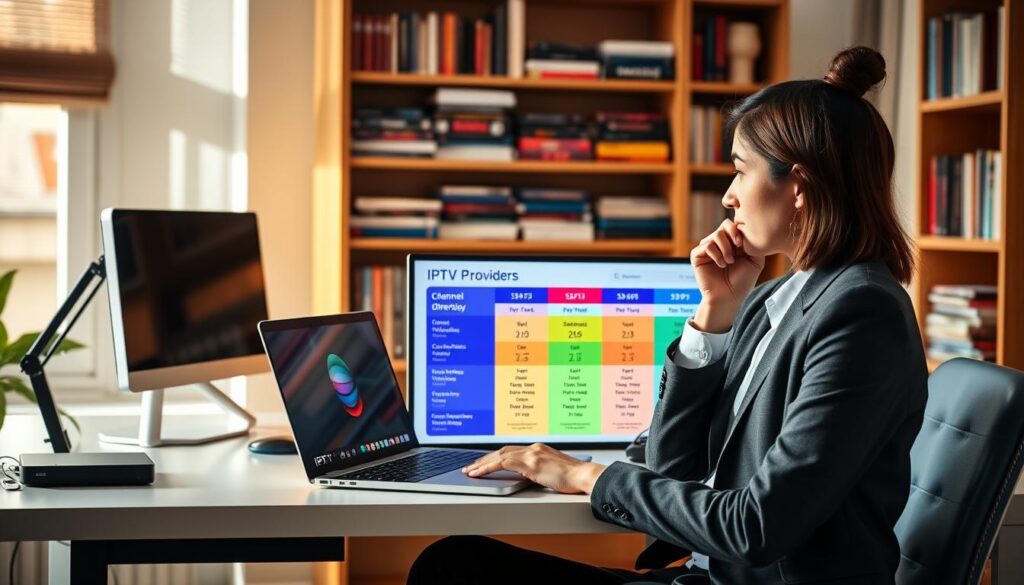
When choosing the best IPTV 2026, don’t just look at the number of channels. It’s easy to advertise a lot of channels. What really matters is the quality of streams, fair pricing, and reliable customer support.
Reliability and peak-hour stability
Check how reliable an IPTV service is by testing it during busy times. Look for reviews that test 100-channel samples and watch for buffering during evening hours and live events.
Choose providers that use multiple CDNs and have redundancy. If a service can’t handle a big game, it’s not reliable for most families.
True stream quality (verified 4K vs labeled 4K)
Many services claim to offer 4K but actually stream in 1080p. Look for verified 4K IPTV channels confirmed with tools, not just provider claims.
For example, SmartiFlix had hundreds of verified 4K channels in recent lab checks. Make sure to check resolution, bitrates, and HDR support during any iptv free trial.
Support response times, pricing transparency, and device compatibility
Test the support at realistic times. A quick response on a Friday night shows a provider can handle demand. SmartiFlix answered a Friday 9 PM test ticket in under ten minutes in one review.
Check the renewal terms and look for clear billing. Avoid services that add fees after the trial or hide auto-renew clauses.
Make sure the service works on Fire TV, Android TV, iOS, and common players like TiviMate. Device limits can make a plan feel smaller than its advertised channel count.
Free trials and how to test a service effectively before committing
Use an iptv free trial or a short plan to test fully. Try wired ethernet and Wi‑Fi, check must-have channels, and stream during peak hours and big sports events.
Verify EPG accuracy, VOD access, and start-over features. Test on multiple devices to catch compatibility problems early.
| Priority | What to test | Why it matters |
|---|---|---|
| iptv reliability | 100-channel uptime sample, peak-hour stress test | Shows real-world stability during evenings and events |
| verified 4K IPTV | Resolution inspection, bitrate check, HDR confirmation | Ensures true 4K quality rather than marketing labels |
| Support response | Submit ticket at Friday 9 PM, try live chat | Measures responsiveness when demand is highest |
| Device compatibility | Test on Fire TV, Android TV, iOS, PC, MAG | Prevents hidden device limits and playback issues |
| Pricing transparency | Check renewal terms, fees, and trial parity | Stops unexpected charges and feature removal after trial |
| iptv free trial | Full feature trial during peak times | Allows side-by-side testing before committing |
Device compatibility and setup differences that affect channel access
Different IPTV devices and apps change how many channels you can access and how fast they appear. Some hardware handles large channel lists and 4K streams better. Other setups slow down when the player loads thousands of entries or high-bitrate feeds.
Setting up Firestick IPTV usually needs a few extra steps. On a Fire TV Stick 4K Max, you can enable unknown sources. Then, install Downloader from the Amazon Appstore. After that, sideload TiviMate or IPTV Smarters via an APK link from your provider.
Large libraries can take 2–5 minutes to populate. Older Fire Stick models with less RAM will struggle. They may show fewer usable channels.
Android TV boxes let you install apps directly from Google Play. TiviMate and IPTV Smarters both support Xtream Codes/API and M3U playlists. TiviMate premium unlock improves the interface and EPG for about $5. This helps when navigating big channel lists.
Samsung Smart TV IPTV options differ. Use the Smart IPTV app for M3U support and a one-time activation fee after a trial. Or sideload apps through developer mode if your model allows it. Screen mirroring from an Android device works when native apps are limited.
iOS users can run IPTV Smarters or GSE Smart IPTV from the App Store. TiviMate remains Android-only. On Windows and macOS, use IPTV Smarters for Windows or VLC to open M3U URLs. Infuse 7 on Mac offers a polished M3U experience for users who prefer a native app.
MAG boxes require a portal URL and the box MAC address to be registered with the provider. Enter the portal under Settings → Servers → Portals and reboot. The box will then load the channel list from the provider portal.
App choice matters. TiviMate gives a TV-first guide and robust EPG handling. IPTV Smarters offers multi-user profiles and simple API logins. VLC can open M3U and M3U8 lists but lacks a modern EPG. Providers often list supported apps and recommended playlist types.
Hardware limits create the impression of fewer channels. Low RAM and weak CPUs on older Android boxes or early Firestick models cause slow loading and dropped streams. Modern hardware such as Fire TV Stick 4K Max, NVIDIA Shield, or Apple TV 4K handles large libraries and 4K feeds reliably.
Network setup defines real-world access. Use wired ethernet for stability when possible. For HD streams, plan on 10–15 Mbps per stream. For 4K, allow 25–50 Mbps per stream. Stable throughput matters more than short bursts of speed when browsing big channel lists or watching live sports.
Common channel availability problems and troubleshooting
Black screens and dead channels are common in IPTV services. SmartiFlix and Nigma.tv quickly remove dead channels and often fix feeds in hours. If many channels stop working, try restarting the app and wait ten minutes before contacting support.
Begin by checking your internet speed. You need at least 10 Mbps for HD and 25 Mbps for 4K. If your speed is good, try setting the quality to fixed HD. This can help reduce buffering.
Buffering during peak hours might be due to server load. Providers that handle heavy traffic well have fewer issues during big events. Try switching servers if possible, or choose a provider known for strong performance during busy times.
VPNs can affect how you stream. Some services block VPNs to prevent misuse. Using a residential-ip VPN or a provider that offers a VPN can help without breaking rules.
Before reaching out for help, gather important details. Include your device model, app version, channel name, and when it stopped working. Also, share your speed test results and any steps you’ve tried.
Good support teams will ask for logs and screenshots. They use this information to find and fix problems. Providers with 24/7 support and clear response times fix issues faster and prevent future problems.
| Problem | Quick checks | Common fixes | When to contact support |
|---|---|---|---|
| Black screen / dead channel | Try other channels, restart app, wait 10 minutes | Server switch, provider rescan, provider-side feed restore | After restart and 10-minute wait if multiple channels stay offline |
| Frequent buffering | Run speed test, check peak hour patterns | Set fixed HD quality, use wired Ethernet, switch server | If speeds are high but buffering persists across devices |
| Geo-block or access denied | Test without VPN, try residential-ip iptv vpn | Use provider-bundled VPN or different server region | If access fails after using recommended VPN settings |
| App crashes / playback errors | Update app, clear cache, test on another device | Reinstall app, use alternative player like TiviMate or VLC | After reproducing issue on two devices with logs/screenshots |
Which IPTV services in 2026 come closest to “all channels” and why
Finding a service with every channel is about size, stability, and quality. In 2026, the market has clear leaders. They focus on different strengths like coverage, sports, regions, or cost.
Top-tested providers and what they excel at
SmartiFlix leads with its huge library of 50,000+ live channels and vast VOD. It offers verified 4K feeds and reliable support. This makes SmartiFlix great for those wanting almost everything at a good price.
TrimixIPTV shines in live sports and events. It streams sports at high bitrates during busy times. This is perfect for fans of big sports events.
TiviPort focuses on regional channels. It has a wide range of Arabic, Turkish, French-African, and Latin American channels. This is ideal for those who want local content.
Zyminex is for those on a budget. It may have fewer channels but is stable and affordable. It offers EPG and HD streams, making it a good value for basic needs.
How specialization shapes channel breadth and quality
Sports-focused providers like TrimixIPTV save capacity for live events. This means better quality during big games but fewer other channels.
International services like TiviPort focus on local content. They have dedicated feeds for different regions. This is great for viewers who want local channels.
Budget services like Zyminex might have fewer channels but are reliable. They use smart engineering and multiple CDNs to offer good service at a low cost.
Price-to-value math in 2026
Traditional cable costs around $97–130 a month. Streaming apps can add up to $100–120. But, a good IPTV plan can cost between $5 and $15 a month and offer more.
The best IPTV services in 2026 offer great value. SmartiFlix and TrimixIPTV have midrange prices but offer lots of content. TiviPort is a bargain for regional viewers. Zyminex is the cheapest option with decent service.
Practical checklist to pick the right plan for must-have channels
- Confirm a free trial and test during a known peak event.
- Verify your must-have channels are active and stable in the trial.
- Check device compatibility for Firestick, Android TV, Samsung Smart TV, iOS, MAG, and PC.
- Ask about true 4K verification rather than just labels.
- Measure support response times during busy hours like Friday nights.
- Ensure simultaneous connections match household needs.
- Compare annual vs monthly pricing to judge IPTV price value and renewal transparency.
Conclusion
IPTV in 2026 is a great, affordable choice compared to cable and streaming services. It offers lots of channels, on-demand shows, and more. You can watch on many devices for just $5–$15 a month.
But, remember, no provider has every channel from around the world. So, this summary suggests being realistic and testing carefully.
What really counts is the provider’s setup and quality. Look for ones with strong infrastructure and reliable streaming. They should have multiple CDN setups and ensure high-quality streams.
It’s also important to check their uptime and channel performance. This is more crucial than just the number of channels they offer.
Try out free trials to see if they have the channels you need. Also, check how well they perform during busy times. Choose providers that are open about their prices and offer good support.
Providers like SmartiFlix, TrimixIPTV, TiviPort, and Zyminex did well in 2026 tests. They focus on stability and quality, which is key. Always test before buying and don’t rely too much on channel lists.