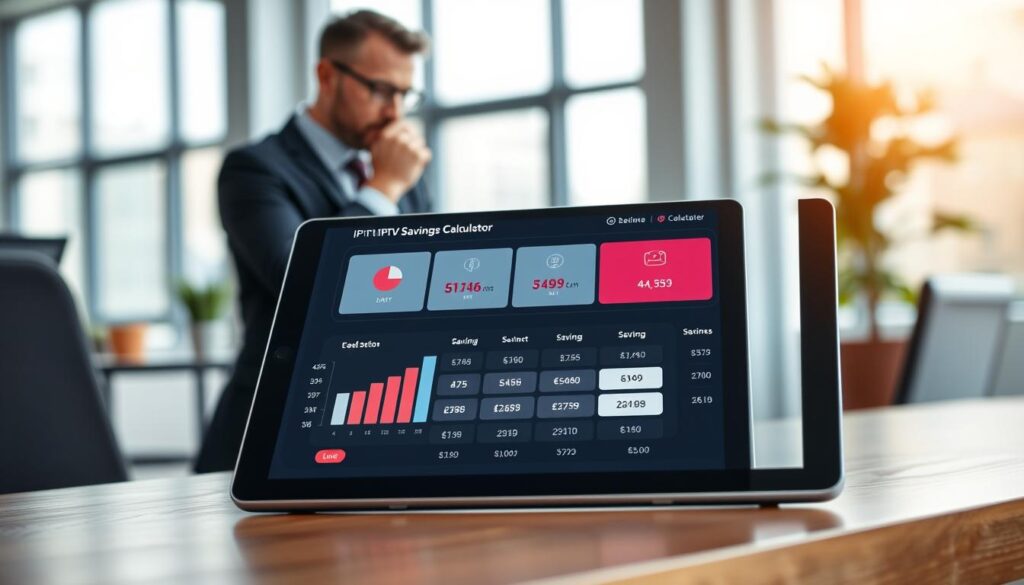
Welcome to the IPTV Savings Calculator page. It’s here to help U.S. viewers figure out how much they can save in 2026. By switching from traditional cable or satellite to IPTV services. This tool lets you compare costs like average cable spend and IPTV plan tiers. You can also see annual discounts to make a smart choice for your entertainment budget.
Americans spend about $2,600 a year on cable on average. Meanwhile, premium IPTV options cost between $60 to $300 annually. For instance, GO BEST IPTV offers a standard rate of $14.99 per month with annual discounts. Switching from a $100/month cable bill to GO BEST IPTV can save you about $85 monthly, or $1,020 annually. Over three years, you could save around $3,060.
Our iptv calculator US model uses real-world figures and common user inputs. It shows both short- and long-term savings. It also highlights cut the cord savings options like monthly vs. annual plans and 24-hour free trials. The site indexes provider info and community submissions, similar to SMZ Services. It also has clear legal pages and contact options like WhatsApp and email for questions.
Ready to see how much you can save on TV bills in 2026? Run the IPTV Savings Calculator now. Try a free trial if available. And compare monthly and annual plans to maximize your cut the cord savings.
Key Takeaways
- Average U.S. cable spend is about $2,600 per year, making IPTV alternatives worth evaluating.
- Premium IPTV plans often range $60–$300 per year; some providers like GO BEST IPTV offer $14.99/month tiers.
- Switching from $100/month cable to a $14.99/month IPTV plan can save roughly $1,020 in one year.
- Use the IPTV Savings Calculator to compare monthly vs. annual pricing and test free trials.
- The site provides indexed provider info and standard legal pages plus contact options for help.
Why You Should Recalculate Your TV Costs in 2026
What used to be stable costs now change every month. The rise in cable prices and inflation make last year’s budget outdated. It’s time to check if promotional rates have ended, new fees have appeared, and if switching to internet TV is wise.
It’s wise to recalculate your TV costs every year. Tools like the IPTV Savings Calculator can help you see the short- and long-term effects. With prepaid plans, multi-year discounts, and small IPTV price increases in 2026, a simple comparison can show big savings for many families.
Current cable pricing trends and inflation impact
Reports show cable prices go up 5–10% each year in many places. This inflation turns a $79.99 promotional package into $150–$185 after the initial period. Now, the average household pays about $150 monthly, or around $2,600 yearly for cable.
An IPTV Savings Calculator captures these trends. Just input the promotional reset increases and tax rates to see the yearly totals. IPTV prices rose slightly in 2026, 3–10%, but still offer more channels and features for less than traditional bundles.
Hidden cable fees that inflate monthly bills
Advertised prices rarely match the final bill. Hidden fees add about 25% to the promotional rate. Common fees include a broadcast TV fee of $20–$30, a regional sports fee of $10–$15, and equipment rental charges of $15–$25 per box.
Long-term renters might have paid $500 or more for hardware that costs about $40 to buy. Taxes and other surcharges also increase the total. Include these fees in any iptv savings calculator to avoid underestimating costs.
How IPTV changes the cost model
IPTV delivers TV over the internet, cutting out much of the cost of physical infrastructure. This shift supports a different cost model: many plans are prepaid, contract-free, and offer month-to-month, quarterly, or annual pricing tiers.
Typical 2026 IPTV tiers range from budget $5–10 per month to premium $20–30. Providers like GO BEST IPTV and mainstream services offer annual discounts that lower the effective monthly rate. One-time hardware, such as a Fire TV Stick for $30–$50, replaces recurring equipment rental.
When using an iptv savings calculator, include one-time hardware, optional VPN fees, cloud DVR charges, and any add-ons. Compare these totals against cable scenarios that list broadcast TV fee, regional sports fee, equipment rental, taxes, and promotional resets. This approach reveals the true monthly and annual costs and shows potential savings from cutting the cord.
| Cost Element | Typical Cable Amount | Typical IPTV Amount |
|---|---|---|
| Base monthly price (promo) | $79.99 | $10–$20 |
| Promotional reset / post-promo | $150–$185 | $10–$30 (annual discounts available) |
| Broadcast TV fee | $20–$30 | Usually included in premium plans |
| Regional sports fee | $10–$15 | Often optional add-on |
| Equipment rental | $15–$25 per box | One-time hardware $30–$50 |
| Taxes & miscellaneous | ~25% of advertised price | Local taxes apply; fewer surcharges |
| VPN / throttling protection | Not typically required | $5/month or ~$60/year |
| Cloud DVR / catch-up | Included or premium tier | $2–$7/month optional |
| Representative annual cost | $1,800–$2,600 | $60–$360 (depending on plan and add-ons) |
IPTV Savings Calculator
Use an IPTV calculator to see real savings before you switch. This tool asks for your current bills, equipment fees, and hidden charges. It also asks for your desired IPTV plan and one-time hardware costs. By entering accurate information, you get clear estimates of short-term and long-term savings.
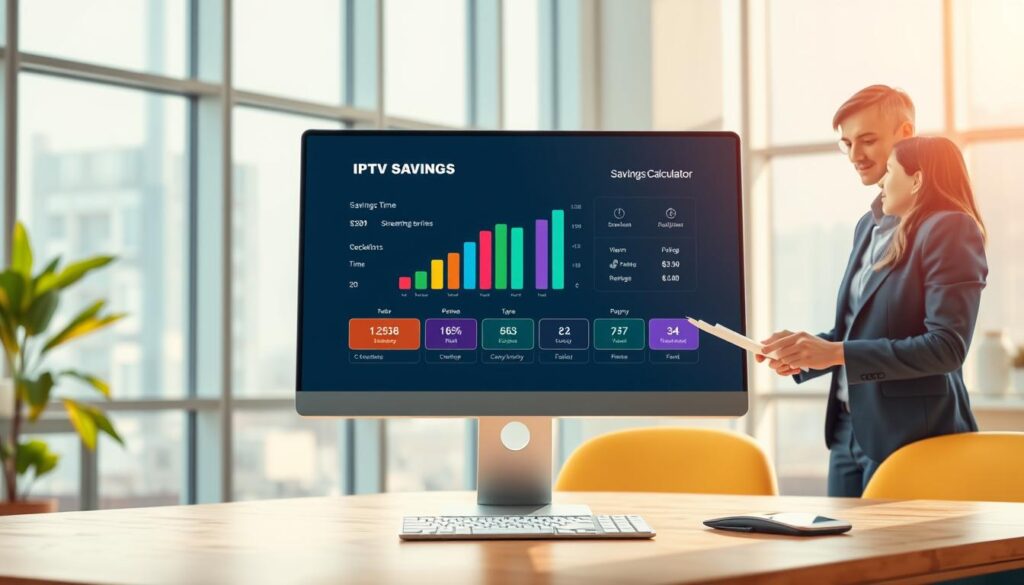
What you enter matters. The calculator fields for IPTV should include your current cable/satellite monthly bill. It should also include promotional prices and expected resets, equipment rental per box, and the number of boxes. Don’t forget to add estimates for broadcast or regional sports fees and taxes.
Next, the tool will compute IPTV savings using simple logic. It calculates net current cable cost and net IPTV cost. This way, you can see your short-term and long-term savings. It shows monthly, annual, and multi-year totals for easy comparison.
Built-in scenarios help you test options quickly. IPTV calculator scenarios include a conservative single-user case and a typical U.S. household. There’s also a sports fanatic and a high-value family plan. Pre-built examples use common defaults like average cable $150/mo and equipment $20/mo.
Sample outputs show clear, actionable numbers. A conservative scenario might show monthly saving and annual totals based on GO BEST IPTV pricing. Typical U.S. household scenarios highlight 1-, 3- and 5-year savings and break-even months for hardware vs ongoing box rentals. Sports-focused examples factor in premium events to illustrate higher possible savings.
Beyond raw totals, the tool offers ROI framing. Enter savings to see what they could buy: a vacation, new gear, or investment growth. A rule-of-thumb example shows how an extra $2,000 invested at 10% can roughly double in seven years. The calculator also tests sensitivity to VPN costs and ISP throttling to show how those choices affect net benefit.
To aid comparison, a sample table below summarizes typical scenario outputs and key calculation points. This way, readers can scan differences and choose the right plan.
| Scenario | Current Monthly Cost | IPTV Plan | One-Time Hardware | 1-Year Savings | 3-Year Savings |
|---|---|---|---|---|---|
| Conservative single user | $100 | GO BEST $14.99/mo | $0* (device owned) | $1,020.12 | $3,060.36 |
| Typical U.S. household | $195 (includes fees) | Standard IPTV $14.99/mo | $50 Firestick | ~$2,240 | Proportional savings over 3–5 years |
| Sports fanatic | $250 (premium sports) | Premium IPTV $24.99/mo | $50 | $500+/mo potential | Large multi-year savings with PPV included |
| High-value family plan | $180 | Premium annual $119.99 | $50 | Significant annual savings | 3-year savings increased by multi-year discounts |
Keep in mind the output depends on precise inputs for number of boxes and hidden fees. Check your last cable bill before you calculate. Use iptv savings calculator examples to validate assumptions, then adjust calculator fields for IPTV until results match your real bills. That process helps you compute IPTV savings with confidence and plan a smarter transition.
Comparing Features and Value: IPTV vs Cable
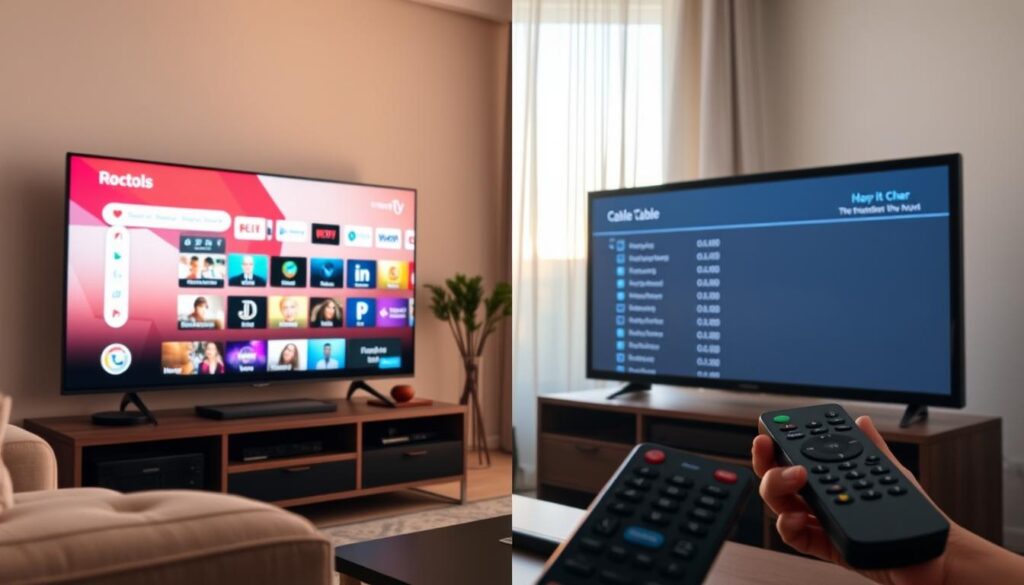
Switching from cable to internet TV offers real choices. Compare channels, on-demand content, streaming quality, and features like DVR and multi-device support. An iptv savings calculator can show the financial benefits while you explore the technical and feature differences yourself.
Channel count, VOD libraries, and content breadth
Cable packages offer about 800 channels, but most people watch around 150. IPTV providers boast 20,000 to 42,000 channels, with some offering 24,000+ live channels and over 100,000 VOD titles. This means you get more bang for your buck with IPTV, especially with prices starting at just $0.0003 per channel.
IPTV VOD libraries combine content from around the world. This is great for families with international ties, offering channels in 50+ countries without extra fees. This makes it easier to access content without needing multiple OTT services.
Quality, reliability, and buffering considerations
Network upgrades and fiber in 2026 have improved v. Many premium services now offer FHD and 4K, often better than cable. Look for clear claims on quality, resolution, and uptime when choosing a provider.
Buffering can still be a problem, especially with cheaper services. Some providers offer anti-freeze IPTV solutions and load-balanced servers to reduce interruptions. Testing free trials and using a VPN can help if ISP throttling is an issue.
Features parity: DVR, catch-up, multi-screen, portability
Cloud DVR on cable costs $10–$20 extra each month. Many IPTV plans include DVR apps like TiviMate or Smarters without extra fees. Make sure to check for DVR support and recording length before committing.
Catch-up TV and replay windows are more common on IPTV. Providers often offer 7-day replay across many channels. Cable catch-up is more limited and tied to network apps. Multi-screen IPTV plans allow several connections at once, unlike cable.
Portability is a big plus for IPTV. It works anywhere with internet, subject to provider rules. Cable service is tied to a fixed address and often requires extra box rentals for other rooms. For those needing mobility and multiple streams, IPTV offers better value.
| Category | Cable (Typical) | IPTV (Premium examples) |
|---|---|---|
| Advertised channel count | ~800 | 20,000–42,000+ |
| Watchable channel average | ~150 | Thousands of curated regional and international channels |
| VOD library | Limited, often separate OTT apps | 100,000+ titles in some services; aggregated VOD options |
| Cost per channel (example) | ~$0.20 | As low as $0.0003 |
| IPTV quality / resolution | Cable HD, some 4K channels | FHD and 4K common with good providers |
| Buffering issues | Less common on stable cable | Depends on provider and network; anti-freeze IPTV tech reduces risk |
| DVR and catch-up TV | Often extra fee; limited catch-up | Many include IPTV features DVR and 7-day catch-up TV |
| Multi-screen / portability | Extra box fees; home-bound | Multi-screen IPTV with simultaneous streams; works on the go |
| Trial & support | Promotional trials; local support | Free trials common; some advertise 99.99% uptime and 24/7 support |
| Value for international users | Costly add-ons | Strong value with broad language packs |
Practical Costs and Transition Plan for Cutting the Cord

Starting a cut the cord plan means knowing your costs and steps. Use an iptv savings calculator to see how much you can save. Small choices at the start can affect your monthly budget and long-term savings.
One-time and recurring costs to expect when switching
First, you’ll need to buy a streaming device like an Amazon Fire TV Stick 4K or an Android box. This costs around $30–$50. This cost can save you money compared to renting a set-top box.
Setting up your new IPTV service takes about 10–15 minutes. You can do it yourself, saving on technician fees.
Monthly IPTV fees vary. Basic plans cost $5–$30. You can find deals like a $14.99 monthly plan or an annual $119.99 option. Longer plans, like 24 months, can make each month cheaper.
There are also optional costs. A VPN costs about $5 a month or $60 a year. Cloud DVR or catch-up upgrades cost $3–$7 a month. Be careful of hidden fees and choose providers with clear pricing.
Step-by-step migration strategy
Start by checking your last cable or satellite bill. Note the price, equipment rental, taxes, and when your contract ends.
Next, pick a device. You can buy a Firestick 4K or use a Smart TV or Android box. Then, choose an IPTV provider with a free trial to test channels, VOD, 4K quality, and reliability.
Test IPTV at home for seven days while keeping cable active. Make sure your internet speed can handle 4K streams and multiple devices. Cancel your cable after a successful trial and when your contract allows it without early termination fees.
Consider annual or multi-year plans to save more money.
Security, legality, and provider selection tips
IPTV legality comes from content licensing and provider legitimacy. The technology itself is legal. Choose reputable, paid providers with uptime records, support, and trials or refunds.
Security is key. Avoid free M3U lists and unknown sources that may carry malware or privacy risks. Use a VPN for privacy and to avoid ISP throttling. Look for providers with clear billing, no activation fees, and compatible devices.
When picking an IPTV provider, look for clear pricing, a free trial, uptime records, EPG and catch-up features, and 24/7 support. Red flags include no trial or support, only crypto payment, frequent interruptions, and no refund policy.
| Cost Type | Typical Range | Notes |
|---|---|---|
| One-time IPTV cost | $30–$50 | Device purchase (Fire TV Stick 4K or Android box); quick DIY setup |
| Recurring IPTV fees | $5–$30/month | Monthly or annual plans; annual and multi-year discounts reduce per-month price |
| VPN (optional) | $5/month or $60/year | Privacy and anti-throttling; recommended for some users |
| Cloud DVR / Catch-up (optional) | $3–$7/month | Useful for time-shifted viewing; varies by provider |
| Hidden fees to avoid | Variable | Avoid providers with activation, rental, or surprise renewal increases |
| Break-even timeline | 1–2 months typical | Firestick purchase vs. box rental; use an iptv savings calculator to confirm |
Use the iptv savings calculator in your cut the cord plan to compare costs. Test services like GO BEST IPTV or other trusted providers with free trials before you cancel. This way, you can switch to IPTV without losing important channels or hidden fees.
Conclusion
The IPTV Savings Calculator shows that IPTV can save U.S. households a lot of money in 2026. Moving from a $100/month cable to a $14.99/month IPTV plan can save over $1,000 a year. Over time, these savings can add up to thousands of dollars.
By using the IPTV Savings Calculator, you can see how much you can save. Just enter your costs, fees, and equipment needs. Remember to include extra costs like VPNs and cloud DVRs for a more accurate picture.
Before making the switch, try out IPTV services with free trials or guarantees. This lets you check the quality before committing to a long-term plan.
Choosing to cut the cord in 2026 is a smart move. IPTV offers better streaming and clearer prices, making it a cost-effective choice. Use the IPTV Savings Calculator to find out how much you can save. Plan your transition carefully and make sure you have the right support and legal information.
FAQ
What is the IPTV Savings Calculator and what can it do for me?
What default values does the calculator use if I don’t know my exact bills?
Which user inputs are essential for accurate results?
How does the calculator treat promotional rates and price increases?
How are hidden cable fees handled in the calculations?
Does the calculator include one-time hardware purchases and how are they amortized?
How does optional VPN or Cloud DVR affect my savings?
Can I compare monthly vs annual or multi-year IPTV plans?
What sample scenarios does the calculator provide?
How reliable are the results and what should I verify before switching?
How does IPTV pricing in 2026 compare to cable, and have IPTV prices changed?
What are the savings drivers when switching to IPTV?
What is the IPTV Savings Calculator and what can it do for me?
What default values does the calculator use if I don’t know my exact bills?
Which user inputs are essential for accurate results?
How does the calculator treat promotional rates and price increases?
How are hidden cable fees handled in the calculations?
Does the calculator include one-time hardware purchases and how are they amortized?
How does optional VPN or Cloud DVR affect my savings?
Can I compare monthly vs annual or multi-year IPTV plans?
What sample scenarios does the calculator provide?
How reliable are the results and what should I verify before switching?
How does IPTV pricing in 2026 compare to cable, and have IPTV prices changed?
What are the savings drivers when switching to IPTV?
FAQ
What is the IPTV Savings Calculator and what can it do for me?
The IPTV Savings Calculator helps U.S. users see how much they can save by switching to IPTV in 2026. It compares your current cable or satellite bill with IPTV prices. You can also add optional features like VPN or DVR.
It shows your monthly, annual, 3-year, and 5-year savings. It also tells you when you’ll break even on hardware costs. Plus, it suggests what you could do with the money you save.
What default values does the calculator use if I don’t know my exact bills?
The calculator uses default U.S.-centric values to speed up results. It assumes an average cable bill of 0/month. It also includes equipment rental, broadcast, and regional sports fees.
For IPTV, it uses 2026 tiers: Budget –10/month, Standard –20/month, and Premium –30/month. You can change these defaults to match your actual bills.
Which user inputs are essential for accurate results?
You need to input your current cable or satellite bill. Include promotional and current prices. Also, add equipment rental costs and the number of boxes.
Don’t forget to include broadcast and regional sports fees, taxes, and other fees. Mention one-time hardware costs, like a Fire TV Stick or Android box. Choose your IPTV plan and billing frequency.
Optional features like VPN and add-ons are also important. Mention the number of simultaneous connections you need. And, choose a time horizon of 1, 3, or 5 years.
How does the calculator treat promotional rates and price increases?
The calculator can handle promotional resets and annual inflation. If your cable has a promotional rate, it will project the price jump after the promotion ends.
It also considers annual price increases. This gives you a realistic view of the costs for both cable and IPTV over time.
How are hidden cable fees handled in the calculations?
Hidden fees are added to your cable bill. These include broadcast TV fees, regional sports fees, equipment rental, and taxes. These fees can add up to about 25% of your monthly bill.
For IPTV, these fees are usually not present. So, it’s important to include them for a fair comparison.
Does the calculator include one-time hardware purchases and how are they amortized?
Yes, the calculator includes one-time hardware costs. You can enter the cost of a Fire TV Stick or Android box. It then spreads this cost over your chosen time horizon.
This shows the true monthly cost of IPTV. It also calculates when you’ll break even on hardware costs compared to renting.
How does optional VPN or Cloud DVR affect my savings?
Optional VPN and Cloud DVR costs are included in the IPTV net cost. The calculator shows how these extras affect your savings. IPTV often remains cheaper even with these add-ons.
Can I compare monthly vs annual or multi-year IPTV plans?
Yes, the calculator allows you to compare different billing options. You can choose monthly, annual, or multi-year plans. It factors in discounts for longer commitments.
This helps you see how switching to a prepaid plan can change your monthly cost and long-term savings.
What sample scenarios does the calculator provide?
The calculator offers various scenarios to help you understand the savings. These include conservative single-user examples and typical U.S. household scenarios.
It also has sports-fan scenarios and high-value family plans. Each scenario shows monthly, annual, and multi-year savings and break-even points.
How reliable are the results and what should I verify before switching?
The calculator’s results depend on the accuracy of your inputs. Make sure to verify your equipment rental counts, broadcast/sports fees, and promotional end dates.
It also flags assumptions, like ISP throttling risk or VPN needs. Try running a free trial with the IPTV provider to confirm channel availability and quality before canceling your cable.
How does IPTV pricing in 2026 compare to cable, and have IPTV prices changed?
IPTV pricing in 2026 is generally lower. Typical tiers are Budget –10/month, Standard –20/month, and Premium –30/month. IPTV prices did increase slightly in 2026.
However, IPTV still offers better value than cable. It eliminates recurring equipment rentals and many hidden fees.
What are the savings drivers when switching to IPTV?
The main savings drivers are eliminating equipment rental and hidden fees. IPTV also offers lower subscription rates and multi-year discounts.
For many users, these savings add up to
FAQ
What is the IPTV Savings Calculator and what can it do for me?
The IPTV Savings Calculator helps U.S. users see how much they can save by switching to IPTV in 2026. It compares your current cable or satellite bill with IPTV prices. You can also add optional features like VPN or DVR.
It shows your monthly, annual, 3-year, and 5-year savings. It also tells you when you’ll break even on hardware costs. Plus, it suggests what you could do with the money you save.
What default values does the calculator use if I don’t know my exact bills?
The calculator uses default U.S.-centric values to speed up results. It assumes an average cable bill of $150/month. It also includes equipment rental, broadcast, and regional sports fees.
For IPTV, it uses 2026 tiers: Budget $5–10/month, Standard $10–20/month, and Premium $20–30/month. You can change these defaults to match your actual bills.
Which user inputs are essential for accurate results?
You need to input your current cable or satellite bill. Include promotional and current prices. Also, add equipment rental costs and the number of boxes.
Don’t forget to include broadcast and regional sports fees, taxes, and other fees. Mention one-time hardware costs, like a Fire TV Stick or Android box. Choose your IPTV plan and billing frequency.
Optional features like VPN and add-ons are also important. Mention the number of simultaneous connections you need. And, choose a time horizon of 1, 3, or 5 years.
How does the calculator treat promotional rates and price increases?
The calculator can handle promotional resets and annual inflation. If your cable has a promotional rate, it will project the price jump after the promotion ends.
It also considers annual price increases. This gives you a realistic view of the costs for both cable and IPTV over time.
How are hidden cable fees handled in the calculations?
Hidden fees are added to your cable bill. These include broadcast TV fees, regional sports fees, equipment rental, and taxes. These fees can add up to about 25% of your monthly bill.
For IPTV, these fees are usually not present. So, it’s important to include them for a fair comparison.
Does the calculator include one-time hardware purchases and how are they amortized?
Yes, the calculator includes one-time hardware costs. You can enter the cost of a Fire TV Stick or Android box. It then spreads this cost over your chosen time horizon.
This shows the true monthly cost of IPTV. It also calculates when you’ll break even on hardware costs compared to renting.
How does optional VPN or Cloud DVR affect my savings?
Optional VPN and Cloud DVR costs are included in the IPTV net cost. The calculator shows how these extras affect your savings. IPTV often remains cheaper even with these add-ons.
Can I compare monthly vs annual or multi-year IPTV plans?
Yes, the calculator allows you to compare different billing options. You can choose monthly, annual, or multi-year plans. It factors in discounts for longer commitments.
This helps you see how switching to a prepaid plan can change your monthly cost and long-term savings.
What sample scenarios does the calculator provide?
The calculator offers various scenarios to help you understand the savings. These include conservative single-user examples and typical U.S. household scenarios.
It also has sports-fan scenarios and high-value family plans. Each scenario shows monthly, annual, and multi-year savings and break-even points.
How reliable are the results and what should I verify before switching?
The calculator’s results depend on the accuracy of your inputs. Make sure to verify your equipment rental counts, broadcast/sports fees, and promotional end dates.
It also flags assumptions, like ISP throttling risk or VPN needs. Try running a free trial with the IPTV provider to confirm channel availability and quality before canceling your cable.
How does IPTV pricing in 2026 compare to cable, and have IPTV prices changed?
IPTV pricing in 2026 is generally lower. Typical tiers are Budget $5–10/month, Standard $10–20/month, and Premium $20–30/month. IPTV prices did increase slightly in 2026.
However, IPTV still offers better value than cable. It eliminates recurring equipment rentals and many hidden fees.
What are the savings drivers when switching to IPTV?
The main savings drivers are eliminating equipment rental and hidden fees. IPTV also offers lower subscription rates and multi-year discounts.
For many users, these savings add up to $1,000+ per year. Over several years, the savings can be in the thousands compared to cable.
Will I lose channels, live sports, or local programming when I switch?
Quality IPTV providers often include a large number of channels. They also carry regional, international, and sports feeds. However, channel lineups can vary by provider.
Use provider free trials to confirm local channels, sports availability, PPV, and blackout policies before switching.
What’s the break-even period for buying a Firestick vs paying set-top box rental?
The break-even period depends on the cost of a Fire TV Stick or Android box. Typical set-top box rental is $15–$25/month. A Fire TV Stick costs about $30–$50.
The calculator computes the break-even month automatically. In most cases, buying a Firestick pays for itself within 1–2 months compared to renting.
Are there quality or buffering risks with IPTV and how can I mitigate them?
Buffering risk depends on your internet connection and ISP behavior. Fiber or higher-speed broadband and providers with strong servers and load balancing reduce risk.
An optional VPN (~$5/month) can help prevent ISP throttling. The calculator factors VPN cost into your net IPTV expense if you choose that protection.
How should I test an IPTV provider before canceling cable?
First, audit your last cable bill. Then, buy or use an existing compatible device. Sign up for a provider’s 24-hour or trial offer.
Test IPTV exclusively for about a week while keeping cable active. Verify channels, VOD, 4K quality, EPG, and DVR features. Then, cancel cable if satisfied.
Is IPTV legal and safe to use?
IPTV is a legal delivery technology. The legality depends on the provider’s content licensing. Prefer paid, reputable providers with clear billing, trials, uptime guarantees, and support.
Avoid unknown free M3U lists and unvetted sources. They can cause downtime, malware risk, or legal exposure. The calculator and FAQ recommend vetted providers and trial periods to confirm legitimacy.
What additional fees should I watch for when choosing a provider?
Watch for activation, setup, or hidden renewal fees. Also, be wary of providers with no refunds or trials. And, payment methods that raise red flags.
Good providers show transparent pricing, no equipment rental, clear trial or money-back guarantees, documented uptime, and customer support. The calculator assumes transparent billing but lets you add any extra fees you encounter.
Can the calculator show what I could do with the money I save?
Yes. The tool includes ROI framing to help visualize savings. You can compare monthly or annual totals to vacation budgets, gadgets, or investment scenarios.
It also highlights the Rule of 72 to show how investing a portion of your savings could double at given return rates.
How do I factor in feature parity like DVR, catch-up, and simultaneous streams?
The calculator lets you add optional DVR or catch-up costs. Specify the number of simultaneous connections you need. Many IPTV providers include DVR or allow multiple streams without box rental.
Enter your required features to get a feature-adjusted cost comparison. This reflects real household needs.
Where can I get provider trials and support if I want to test services mentioned by the calculator?
The FAQ recommends trying providers that offer 24-hour or longer trials and documented support. Examples in recent market data include providers with 24-hour free trials and money-back guarantees.
Test channel availability and quality during the trial. Use provider contact options (WhatsApp or email) for setup help. Always keep your cable active until you confirm IPTV meets your needs.
Does the site provide legal pages and contact options like other index-style services?
Yes. The site follows a vendor/index disclaimer approach. Indexed content may include user-submitted or enthusiast-sourced listings. It maintains standard legal pages (Privacy Policy, Terms of Service, Disclaimer) plus contact options (WhatsApp and Email).
Users can get support and report issues during their migration.
,000+ per year. Over several years, the savings can be in the thousands compared to cable.
Will I lose channels, live sports, or local programming when I switch?
Quality IPTV providers often include a large number of channels. They also carry regional, international, and sports feeds. However, channel lineups can vary by provider.
Use provider free trials to confirm local channels, sports availability, PPV, and blackout policies before switching.
What’s the break-even period for buying a Firestick vs paying set-top box rental?
The break-even period depends on the cost of a Fire TV Stick or Android box. Typical set-top box rental is –/month. A Fire TV Stick costs about –.
The calculator computes the break-even month automatically. In most cases, buying a Firestick pays for itself within 1–2 months compared to renting.
Are there quality or buffering risks with IPTV and how can I mitigate them?
Buffering risk depends on your internet connection and ISP behavior. Fiber or higher-speed broadband and providers with strong servers and load balancing reduce risk.
An optional VPN (~/month) can help prevent ISP throttling. The calculator factors VPN cost into your net IPTV expense if you choose that protection.
How should I test an IPTV provider before canceling cable?
First, audit your last cable bill. Then, buy or use an existing compatible device. Sign up for a provider’s 24-hour or trial offer.
Test IPTV exclusively for about a week while keeping cable active. Verify channels, VOD, 4K quality, EPG, and DVR features. Then, cancel cable if satisfied.
Is IPTV legal and safe to use?
IPTV is a legal delivery technology. The legality depends on the provider’s content licensing. Prefer paid, reputable providers with clear billing, trials, uptime guarantees, and support.
Avoid unknown free M3U lists and unvetted sources. They can cause downtime, malware risk, or legal exposure. The calculator and FAQ recommend vetted providers and trial periods to confirm legitimacy.
What additional fees should I watch for when choosing a provider?
Watch for activation, setup, or hidden renewal fees. Also, be wary of providers with no refunds or trials. And, payment methods that raise red flags.
Good providers show transparent pricing, no equipment rental, clear trial or money-back guarantees, documented uptime, and customer support. The calculator assumes transparent billing but lets you add any extra fees you encounter.
Can the calculator show what I could do with the money I save?
Yes. The tool includes ROI framing to help visualize savings. You can compare monthly or annual totals to vacation budgets, gadgets, or investment scenarios.
It also highlights the Rule of 72 to show how investing a portion of your savings could double at given return rates.
How do I factor in feature parity like DVR, catch-up, and simultaneous streams?
The calculator lets you add optional DVR or catch-up costs. Specify the number of simultaneous connections you need. Many IPTV providers include DVR or allow multiple streams without box rental.
Enter your required features to get a feature-adjusted cost comparison. This reflects real household needs.
Where can I get provider trials and support if I want to test services mentioned by the calculator?
The FAQ recommends trying providers that offer 24-hour or longer trials and documented support. Examples in recent market data include providers with 24-hour free trials and money-back guarantees.
Test channel availability and quality during the trial. Use provider contact options (WhatsApp or email) for setup help. Always keep your cable active until you confirm IPTV meets your needs.
Does the site provide legal pages and contact options like other index-style services?
Yes. The site follows a vendor/index disclaimer approach. Indexed content may include user-submitted or enthusiast-sourced listings. It maintains standard legal pages (Privacy Policy, Terms of Service, Disclaimer) plus contact options (WhatsApp and Email).
Users can get support and report issues during their migration.